
Cast iron gutters and downpipes are part of the character of Edinburgh’s tenements, terraces and villas. Looked after properly they last for generations, but once the paint fails and the joints start to leak they deteriorate quickly, and the water they should be carrying ends up in the stonework.
This guide covers the signs that cast iron gutters need attention, why they fail, how repairs are carried out, and how to plan maintenance so small problems stay small.
Signs that cast iron gutters need repair
Outside the building
- Water spilling over the gutter during heavy rain
- Rust, cracks or dripping at the joints
- Plants, moss or algae growing from the gutter or hopper
- Dark staining or green streaks on the stonework below
- Eroded or washed-out pointing under a joint or outlet
Inside the building
- Damp patches on walls near the line of a gutter or downpipe
- Peeling paint or blown plaster on the top floor or in the stairwell
- Musty smells or mould in rooms on an outside wall
Internal damp next to a downpipe is often a leaking joint or a crack on the back of the pipe, where it cannot be seen from the ground.
Why cast iron gutters fail
Missed maintenance
Most failures start with gutters that have not been cleared or painted for years. This is especially common on tenements and shared buildings, where no single owner takes responsibility and access is difficult.
Blockages
Leaves, moss and silt build up, the gutter overflows and water runs down the face of the building. Left long enough, this saturates the stone and can lead to damp inside.
Frost damage
Water trapped in a blocked gutter or downpipe freezes and expands. Cast iron is brittle, so the expansion can crack a section or split a joint.
Corrosion
Cast iron only lasts while it is protected. Once the paint breaks down, rust starts at joints, brackets and the back of the gutter where it cannot be seen, and the metal thins until it cracks.
Loose brackets and misalignment
Corroded or loose brackets let a gutter sag, so water ponds instead of running to the outlet. Prompt correction stops further damage to the gutter, the stonework and the building.
How cast iron gutter repairs are carried out
Most repairs are done section by section rather than replacing the whole run:
- Resealing joints. The joint is taken apart, cleaned back to bare metal, resealed with a suitable gutter sealant and rebolted with new nuts and bolts.
- Replacing cracked sections. Damaged lengths, outlets or hoppers are replaced like for like with new cast iron, matched to the existing profile.
- Resetting brackets. Corroded brackets are replaced and the gutter is reset to a proper fall towards the outlet.
- Clearing downpipes. Blocked downpipes are cleared and tested, and cracked lengths are replaced.
On listed buildings and in conservation areas, like-for-like cast iron replacement is usually expected. If you are unsure whether consent is needed, check with the council’s planning department before work is booked.
Painting and rust protection
Painting is what keeps cast iron going. Loose rust is removed by wire brushing or mechanical cleaning, the bare metal is primed with a rust-inhibiting primer, and a protective topcoat is applied. The insides of gutters can be coated with a bitumen-based paint to protect the surface that holds water. Repainting on a regular cycle, before rust takes hold, is far cheaper than replacing sections later.
Why rope access suits cast iron gutter work
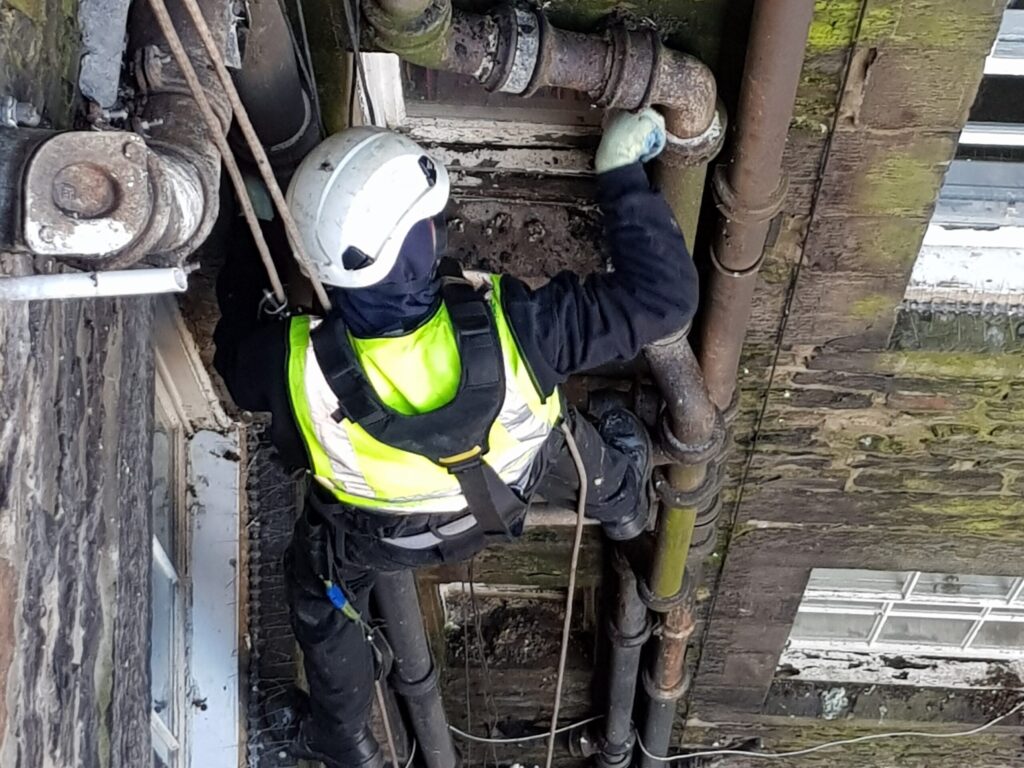
High-level gutters on tenements and tall buildings are expensive to reach with scaffolding, especially at the rear or in light wells. Rope access lets technicians reach the gutter, hopper or downpipe directly, carry out the repair and leave without a scaffold being erected. For long runs of replacement or full repainting of an elevation, scaffolding can still be the better option.
Creating a maintenance plan
A simple plan keeps cast iron gutters working:
- Clear gutters, hoppers and outlets at least once a year, ideally after autumn leaf fall. See gutter cleaning.
- Check joints and brackets at the same visit and deal with small leaks straight away.
- Repaint on a regular cycle before the paint fails completely.
- Keep photos and records of the work, which helps with shared repairs and insurance.
Need a hand with this?
If your cast iron gutters are leaking or overflowing, we can inspect them and tell you what needs repaired. See our gutter repairs page, or request a quote and send us a photo. You can also call 0131 235 1019.